Angke Kapuk is easy to miss on a map of Jakarta, a green sliver squeezed between the Java Sea and one of Southeast Asia's densest coastlines. But fly a drone over it and the picture is stark: ninety-nine hectares of protected parkland, only around 57 percent of it still under real mangrove canopy, its roots and boardwalks hemmed in on almost every side by apartment towers, toll roads and reclaimed land. It is one of the last true mangrove ecosystems left on Jakarta Bay, and it is doing an enormous amount of ecological work for a city that rarely notices it.
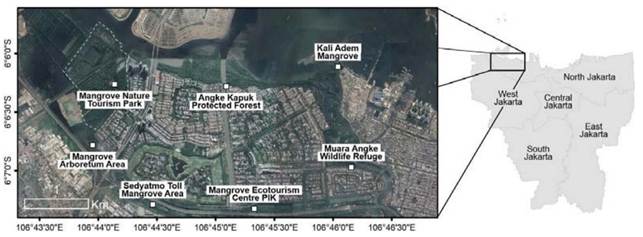
Figure 1. Angke Kapuk Mangrove Area on the north coast of Jakarta. Source: Abdurrahman et al. (2024).
A forest doing a city's dirty work
Angke Kapuk protects the capital's northern edge from abrasion and seawater intrusion, stores well over a hundred tonnes of carbon per hectare in its trees alone, and measurably cools the neighbourhoods around it. None of that is guaranteed to last. The forest sits at the exact point where Jakarta's expansion pressure is highest, and the pressures are not slowing down.
The pressures are not abstract, and they are not slowing down
Two decades of land-cover data make the scale of change hard to miss: built-up land around the Muara Angke–Kapuk mangroves grew from about 716 hectares in 2005 to more than 1,525 hectares in 2024, while land surface temperature climbed by roughly 7.5°C over the same period. Reclamation has been a consistent driver of that shift since the 1990s, and researchers studying the park have repeatedly flagged it, alongside fragmentation and settlement pressure, as one of the central threats to the forest's long-term integrity.
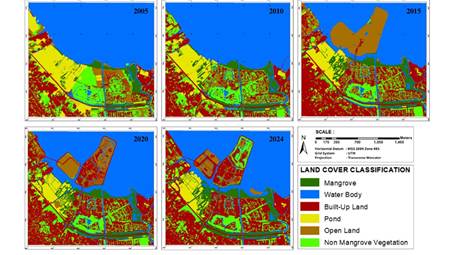
Figure 2. Land cover change around the Muara Angke–Kapuk mangroves, 2005–2024. Built-up land (red) has steadily displaced water bodies and open land as the coastline urbanises. Source: Isdianto & Anggraini (2025), Engineering, Technology & Applied Science Research, CC BY 4.0.
Pollution compounds the problem. Water and sediment samples around the park have found lead tied to vessel traffic, maintenance and reclamation work, and while concentrations sit below international sediment thresholds, researchers monitoring the site are explicit that heavy metals in an ecotourism zone still deserve sustained attention. Plastic waste is the more visible problem: it arrives via rivers and tides, snags in the mangrove roots, and does not leave. It has been linked to measurable declines in specific waterbird species that forage in the park, and it is altering the nutrient balance of the sediment the mangroves grow in. The park's own popularity works against it too: visitor numbers average well over 130,000 people a year, and every additional boardwalk, jetty and access road is a small new pressure on a forest already squeezed from outside.
What the forest is actually worth keeping
The ecological case for Angke Kapuk is not sentimental, it is measurable. Field surveys have recorded thirteen mangrove species here, dominated by Avicennia marina, and the forest anchors a bird community that includes waterbirds rarely seen elsewhere on this stretch of coast. Its blue carbon stock, measured across dozens of field plots, averages around 111.6 tonnes of carbon per hectare in standing forest, and ranges from roughly 35 up to 237 tonnes per hectare in rehabilitated stands depending on how established they are, a genuine climate asset sitting inside a megacity. The trees measurably absorb urban air pollutants and cool the surrounding land surface even as the built environment around them heats up, and independent economic valuation puts the park's total annual ecosystem value at close to eighteen billion rupiah. Every one of those services depends on the forest staying structurally intact, not just present on a map.
Restoration is necessary. It is not sufficient.
This is where I think the conversation about Angke Kapuk usually goes wrong. Restoration gets treated as the finish line, when the park's own data shows it is closer to a starting point. Mangrove cover in the wider Muara Angke–Kapuk area actually grew by more than three-quarters between 2005 and 2024, evidence that planting programmes are adding hectares. But NDVI monitoring over a much shorter and more recent window, 2018 to 2023, recorded roughly thirteen hectares of degradation inside the tourism park itself, and rehabilitation trials using the local guludan mounding technique have recorded seedling survival rates as low as 22 to 57 percent depending on the cohort. Area and health are not the same thing, and a restoration programme that is only tracked by hectares planted can mask a forest that is quietly thinning from the inside.
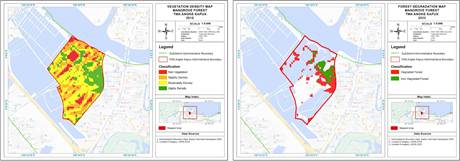
Figure 3. Vegetation density in 2018 (left) versus detected forest degradation in 2023 (right) inside the Mangrove Nature Tourism Park. Red areas mark non-vegetated or degraded ground even within the protected boundary. Source: Suryana et al. (2024), European Journal of Forest Engineering, CC BY-NC 4.0.
What actually protects a forest under this pressure is not one more planting season, it is the unglamorous work of monitoring, enforcement and governance that makes restoration durable. That means routine, repeatable tracking of canopy density, not a one-off survey; someone with authority to act when reclamation or waste dumping encroaches on the protected boundary; and treating the community around the park, especially ecotourism businesses, as partners in enforcement rather than a pressure to be managed from outside. Remote sensing already shows what this looks like in practice: Landsat-based vegetation indices have tracked canopy degradation year over year, object-based land-cover classification has quantified the mangrove cooling effect against a two-decade heat record, and combining field-measured carbon plots with satellite vegetation indices, though still imperfect, is starting to produce carbon maps precise enough to guide where rehabilitation money should go. None of this needs to stay in academic papers. Drone and satellite monitoring are cheap enough now to run on a standing schedule; Jakarta's park managers do not lack data, they lack a mandate to act on it consistently.
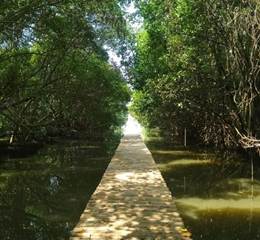
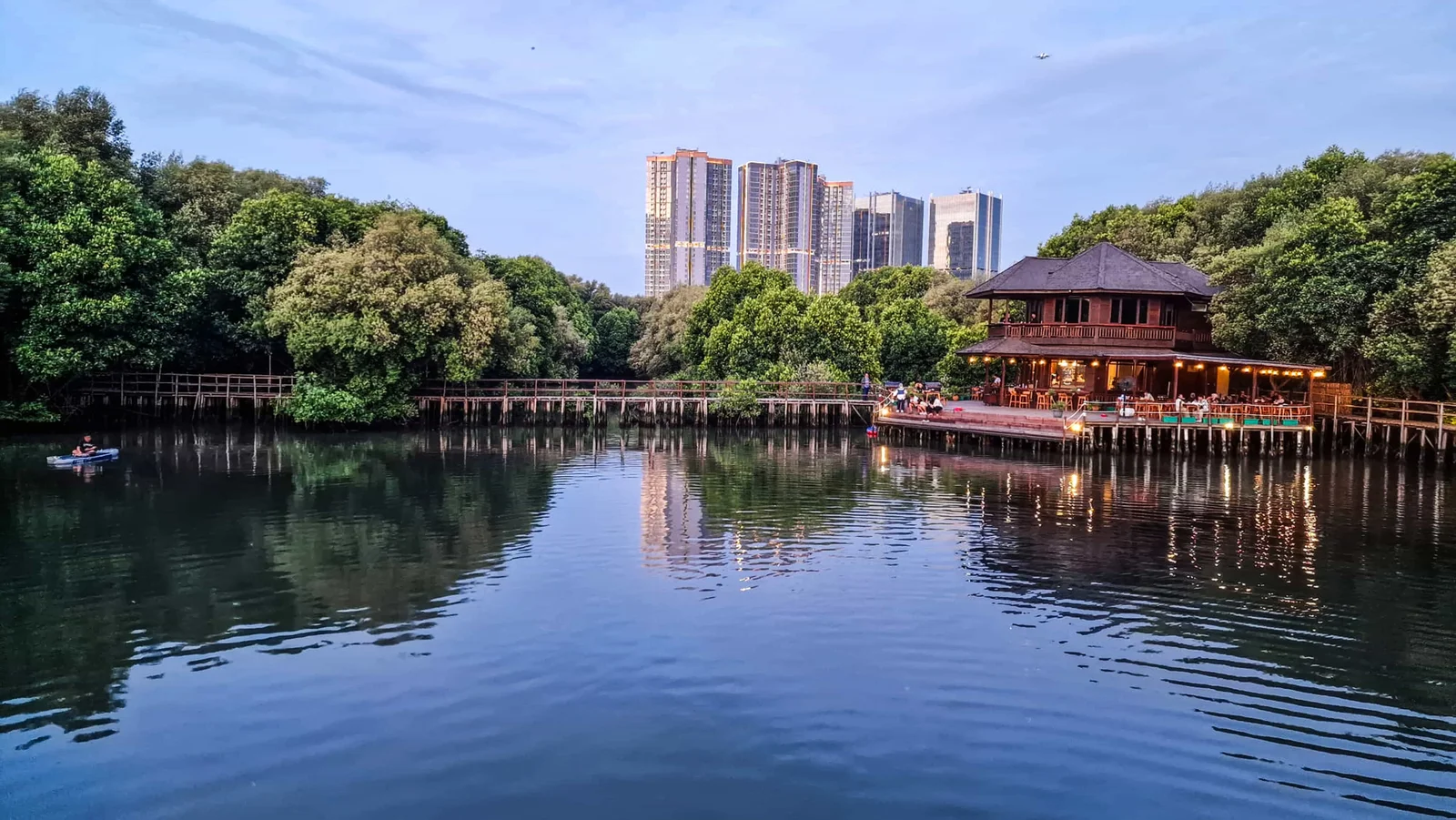
Figure 4. A boardwalk through the Angke Kapuk mangrove canopy: the same access infrastructure that supports ecotourism and environmental education also concentrates foot traffic and disturbance. Source: Suryana et al. (2024), European Journal of Forest Engineering, CC BY-NC 4.0.
A resilient coastline has to be built, not just planted
Angke Kapuk will not survive as an ecological island inside an expanding megacity by accident. It will survive because monitoring catches degradation before it becomes irreversible, because enforcement holds the line against reclamation and encroachment, and because the people who use the park every day have a real stake in defending it. Jakarta does not need a bigger mangrove forest so much as it needs a mangrove forest that is actively managed as critical urban infrastructure, on par with a seawall or a drainage canal. Get that right at Angke Kapuk, and the model travels to every other coastal megacity trying to hold its green edge against the tide of its own growth.
References
Abdurrahman, U., Pratyaksa, I. F., Nur, A. A., Jeon, C. K., Radjawane, I. M., & Park, H. S. (2024). Mangrove mapping and carbon stock estimation at Taman Wisata Alam Mangrove, Angke Kapuk, North Jakarta, Indonesia. IOP Conference Series: Earth and Environmental Science, 1410, Article 012041. https://doi.org/10.1088/1755-1315/1410/1/012041
Andriani, Y., Fitri, A. D. P., Arief, M. C. W., & Zahidah. (2025). Lead pollution in the Angke Kapuk mangrove forest of the Jakarta Bay area. Polish Journal of Environmental Studies, 34(1), 13–20. https://doi.org/10.15244/pjoes/185542
Anugra, B. G., Winarni, N. L., Pradana, D. H., Ayujawi, S. A., Wulandari, Y., Syahruddin, D., & Yasman. (2021). Living on polluted habitat: A preliminary study of marine debris impact to foraging waterbirds in Muara Angke Mangrove Ecosystem, Jakarta. E3S Web of Conferences, 324, Article 03011. https://doi.org/10.1051/e3sconf/202132403011
Ashari, R., Kusmana, C., & Kuncahyo, B. (2019). Evaluation of mangrove stand planted for rehabilitation using guludan technique in coastal area of Angke Kapuk, Jakarta. IOP Conference Series: Earth and Environmental Science, 308, Article 012056. https://doi.org/10.1088/1755-1315/308/1/012056
Chairunissa, N. A., Osmaleli, & Kusumastanto, T. (2024). Economic value of mangrove ecosystem management in Angke Kapuk Natural Tourism Park. IOP Conference Series: Earth and Environmental Science, 1366, Article 012003. https://doi.org/10.1088/1755-1315/1366/1/012003
Herawati, T., & Januaristy, D. C. (2023). Total organic matter, carbon organic, nitrate, phosphate content in sediment at mangrove ecosystem of Angke Kapuk Protected Forest, DKI Jakarta. BIO Web of Conferences, 74, Article 05007. https://doi.org/10.1051/bioconf/20237405007
Isdianto, A., & Anggraini, I. A. (2025). Quantifying the mangrove cooling effects on urban heat: A two-decade remote sensing analysis of Jakarta's coastal zone. Engineering, Technology & Applied Science Research, 15(6), 29731–29737. https://doi.org/10.48084/etasr.14093
Rumondang, A. L., Kusmana, C., & Budi, S. W. (2021). Species composition and structure of Angke Kapuk Mangrove Protected Forest, Jakarta, Indonesia. Biodiversitas, 22(9), 3863–3871. https://doi.org/10.13057/biodiv/d220932
Sumarga, E., Sholihah, A., Srigati, F. A. E., Nabila, S., Azzahra, P. R., & Rabbani, N. P. (2023). Quantification of ecosystem services from urban mangrove forest: A case study in Angke Kapuk Jakarta. Forests, 14(9), Article 1796. https://doi.org/10.3390/f14091796
Sumarga, E., Syamsudin, T. S., Sarah, S., Qalbi, M. P., Tansy, B. C., Basyuni, M., & Larekeng, S. H. (2025). Mapping aboveground carbon in rehabilitated mangrove: Evaluating the performance of regression modelling with satellite-derived vegetation indices and kriging interpolation. Journal of Multidisciplinary Applied Natural Science, 6(1). https://doi.org/10.47352/jmans.2774-3047.311
Suryana, T. N., Purnamasari, S., & Ewaldo, K. (2024). Monitoring mangrove forest degradation in Mangrove Nature Tourism Park Angke Kapuk, North Jakarta, Indonesia using NDVI. European Journal of Forest Engineering, 10(1), 29–42. https://doi.org/10.33904/ejfe.1395676
Winarni, N. L., Pradana, D. H., Ayujawi, S. A., Zackeisha, N., Anugra, B. G., Wulandari, Y., & Syachrudin, D. (2022). Problems in paradise: Mangrove bird communities impacted by litter in Jakarta Bay, Indonesia. Ocean and Coastal Management, 225, Article 106223. https://doi.org/10.1016/j.ocecoaman.2022.106223